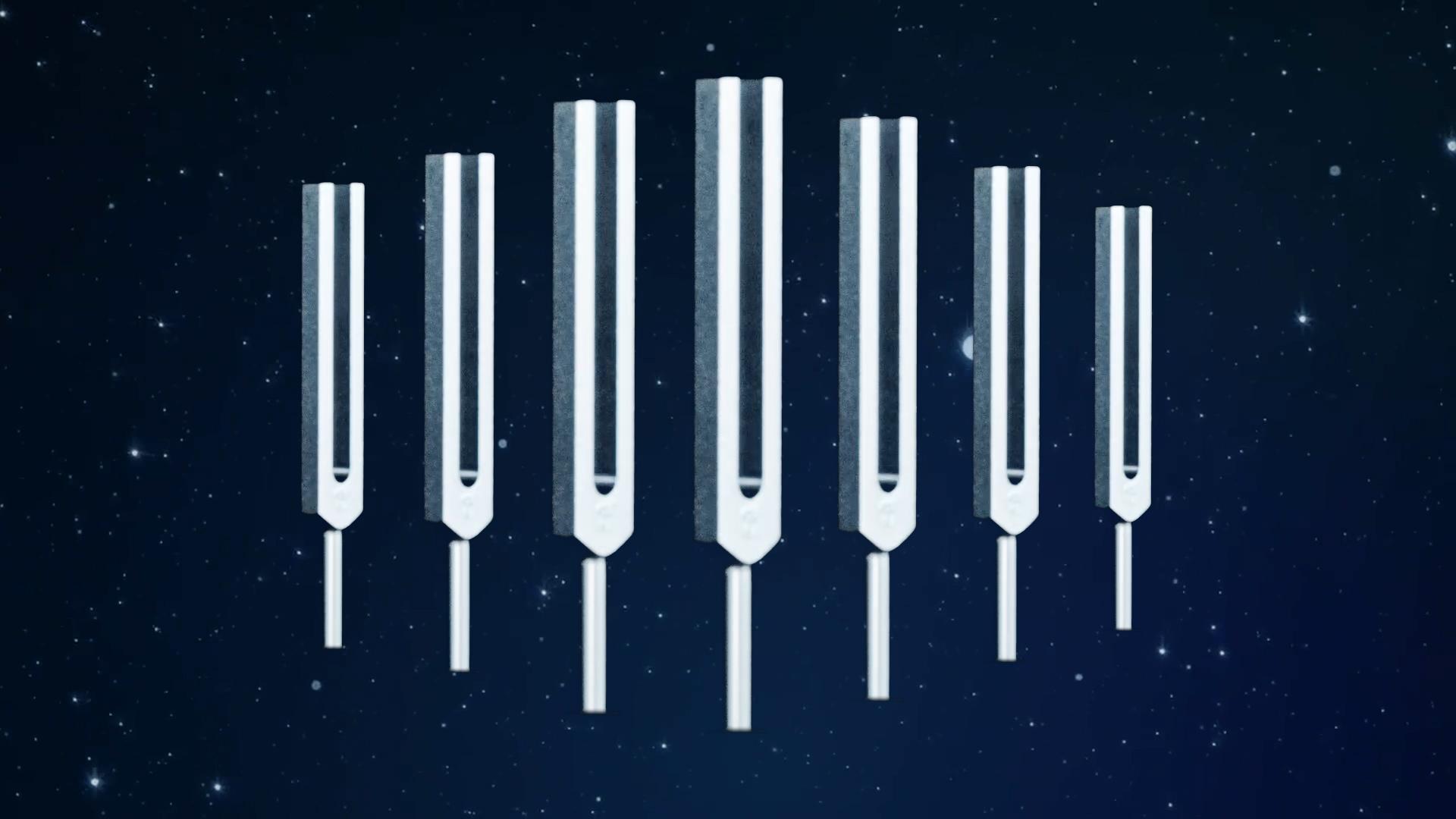
History, practice lineages, esoteric frames, and modern interpretation This paper distinguishes carefully between what can be documented historically (the tuning fork as a tool of standard pitch, measurement, and clinical examination), what can be documented about modern tuning-fork lineages (named authors, institutions, and teaching methods), and how tuning forks are used today as a practical symbolic system. The aim is not to police modern wellness practice, but to strengthen it intellectually by keeping history, lineage, and interpretation clearly separated.
Contents
Framing the instrument: what a tuning fork is and why it matters
Origins and standard pitch: Shore's 1711 fork and the culture of calibration
The fork in medicine and measurement: hearing tests and vibration sense
From oscillator to ritual tool: why stable tone becomes practice
Esoteric frames: vibration metaphysics and music as inner work
Contemporary tuning-fork lineages: Beaulieu, Goldman, McKusick, and the wider field
Research touchpoints: what the literature helps us understand
A modern wellness-style interpretation that stays intellectually honest
Framing the instrument: what a tuning fork is and why it matters
A tuning fork is a deliberately simple resonator: two metal tines joined at a stem, engineered so that, after the initial strike, it settles into a stable, repeatable tone. That repeatability is its quiet power. It made the tuning fork a cornerstone of musical calibration, a compact instrument for demonstrating acoustics, and, in the modern era, a precise way to bring the idea of "frequency" into direct experience, heard as tone and, with weighted forks, felt as vibration.
In this context, tuning forks matter for two reasons. First, they are historically grounded tools of standardisation and measurement. Second, they have become a widely used contemporary modality with identifiable teaching lineages and a recognisable practice grammar: choices about fork type, interval logic, contact vs near-field use, and the role of attention and intention in how the work is framed. Modern practice often connects forks to chakra work, Solfeggio frequencies, and the tuning body metaphor.
Origins and standard pitch: Shore's 1711 fork and the culture of calibration
The tuning fork is generally credited to John Shore, a musician at the English royal court, in 1711. In an era when pitch could vary by city, ensemble, season, and instrument-maker, a fork offered something unusually modern: a portable reference that resisted the humidity and temperature problems of wooden pitch pipes. Museum and music-history accounts treat this as the fork's essential contribution: it stabilised the idea of a "standard pitch" long before global concert pitch norms were agreed.
Once a stable oscillator exists, it travels easily between domains. In music, it anchors tuning and instrument making. In science and engineering, it becomes a teachable example of resonance, decay, and radiation; how vibration in a solid couples into the air. That cross-domain portability helps explain why the tuning fork later becomes such a natural object for wellness cultures that speak in the language of vibration; the fork already carries the prestige of precision.
The fork in medicine and measurement: hearing tests and vibration sense
Tuning forks also entered clinical and experimental practice, especially in the assessment of hearing via air and bone conduction. The family of bedside tuning-fork tests (most famously the Rinne test) remains a well-known demonstration of how the ear routes vibration, through the air to the tympanic membrane and ossicles, and through bone conduction to the cochlea.
A second, related pathway is the use of a vibrating fork (often 128 Hz) in neurological examination contexts to check vibration sensation. Contemporary clinical studies have evaluated tuning-fork-based approaches alongside other instruments for vibration perception testing.
Whatever the context, the underlying fact is straightforward: the body registers vibration reliably, and a tuning fork provides a remarkably consistent stimulus.
From oscillator to ritual tool: why stable tone becomes practice
If the tuning fork began as a calibration device, its wellness reinvention begins with a simple practical insight: a stable tone can organise attention. In many contemplative traditions, repetition is not a shortcut but a technology; what trains perception is the return to the same stimulus. A fork makes that return easy; one sound, repeatable, portable, and consistent across time.
Modern tuning-fork work often pivots on two instrument choices. Unweighted forks project a clearer audible pitch; weighted forks emphasise tactile vibration and can feel more localised when applied through contact. In practice, these are not competing philosophies so much as different entry points: one privileges listening, the other privileges sensation. Many contemporary methods mix both.
A second pivot is interval logic versus named-frequency logic. Some approaches build from musical consonances (octaves, fifths, harmonic relationships); others build from sets of specific Hertz numbers that carry symbolic associations (planetary correspondences, chakra sets, or "OM" forks). In lived use, the difference is less about "right or wrong" and more about what kind of coherence a system offers the mind: relational coherence (music) or address-based coherence (a fixed palette of numbers).
Esoteric frames: vibration metaphysics and music as inner work
Modern frequency culture sits inside a broader Western esoteric habit of thought: sound is treated not only as sensation but as a formative principle. The language of "vibration" functions here as a bridge, part physics vocabulary, part metaphysical idiom. In that idiom, a tone is not merely heard, it is understood as participating in an order that shapes mind, body, and meaning.
Within popular esotericism, The Kybalion compresses this worldview into a simple claim: reality is never at rest; everything is in motion. This is often invoked in modern wellness contexts not as historical proof for any particular frequency set, but as a conceptual permission slip, an explanation of why "working with vibration" feels philosophically coherent.
Rudolf Steiner's anthroposophical vocabulary offers a different emphasis. Across lectures on art, speech, rhythm, and the formative forces of life, Steiner repeatedly treats tone and rhythm as more than decoration: they are modes of ordering experience. In this frame, sound is a way of shaping attention and vitality through pattern, especially through repetition, interval relationship, and the disciplined perception of nuance.
A third, especially useful anchor for tuning forks is George Ivanovich Gurdjieff. Gurdjieff's teaching places unusual weight on practice; attention, self-observation, and the integration of mind, feeling, and body. In his tradition, music is not peripheral. Through the collaboration of Gurdjieff and the composer Thomas de Hartmann, music served as a practical support for inner work, including the "Movements" (sacred dances) where rhythm, gesture, and precise timing are used to educate attention. The relevance for tuning forks is not that Gurdjieff used forks, but that he models an approach where sound is treated as a tool for training presence: a repeatable stimulus that asks for a repeatable quality of listening.
Contemporary tuning fork lineages: Beaulieu, Goldman, McKusick, and the wider field
In modern sound-based wellness culture, tuning forks thrive because they combine precision with simplicity. Their contemporary "genealogy" is best traced through identifiable authors and methods rather than through claims of antiquity.
John Beaulieu (ND, PhD): Human Tuning and the nervous system lens
John Beaulieu's Human Tuning is one of the most widely cited modern manuals for working with tuning forks. His approach tends to frame forks as tools for restoring harmony through the body's responsiveness to sound and vibration, with a practical emphasis on fork selection, placement, and the use of consonant interval relationships (including the perfect fifth) as a stable organising pattern.
Jonathan Goldman: harmonics, intention, and a usable practice grammar
Jonathan Goldman's influence is partly historical and partly stylistic: he helped give modern sound healing a clear "practice grammar" by emphasising that sound is not only a frequency but also an act of consciousness. His familiar formula linking frequency with intention has shaped how many people understand why tone is used repeatedly: the tone stabilises an environment; intention supplies direction; repetition supplies training.
Eileen Day McKusick: Biofield Tuning and the mapped-field approach
Eileen Day McKusick's Tuning the Human Biofield introduces a distinctive method in which tuning forks are used not only to generate sound but also to locate and work with patterns perceived in the human biofield. The system is presented with a map-like structure (a "biofield anatomy") and a specific way of using a fork's tone response in space as feedback during the process.
Beyond these three anchors, the wider field includes approaches that integrate forks with bodywork settings, meditative listening, and various correspondence systems (chakra sets, planetary mappings, or interval-based pairs). Across this diversity, the most consistent through-line is methodological rather than doctrinal: a repeatable stimulus, applied with repeatable attention, inside a coherent framework.
Research touchpoints: what the literature helps us understand
Research relevant to tuning forks does not need to "prove spirituality" to be useful. Its value is explanatory: it helps clarify pathways by which sound and vibration can influence experience, and it sharpens language around resonance, perception, and regulation.
A widely cited narrative review by Lee Bartel surveys proposed mechanisms for how sound vibration may affect humans, focusing especially on low-frequency sound and vibroacoustic applications. The point for tuning-fork work is orientation: vibration can be approached as a multisystem stimulus (auditory, vibrotactile, attentional, autonomic), not merely as a "note".
At the clinical end of the spectrum, tuning forks remain canonical tools for demonstrating air and bone conduction in hearing assessment and for testing vibration perception. This reinforces a practical, experience-near fact: a fork is a reliable way to deliver a consistent vibratory event. In modern wellness settings, that consistency is part of what makes the work feel learnable and repeatable.
A modern wellness-style interpretation that stays intellectually honest
A useful way to understand tuning forks in modern wellness culture is to separate four layers that often travel together. Acoustic layer: a clean stimulus A tuning fork offers a constrained signal: one dominant frequency with a predictable decay profile once the initial overtones fade. This constraint is not a limitation---it is what gives the fork its clarity. A clean stimulus reduces interpretive load and can make attention feel steadier. Somatic layer: vibration as an anchor Weighted forks make "frequency" tangible. When vibration is felt through contact, attention is naturally drawn into specificity: where the sensation is, how it changes, and how the body relates to it over time. This tactile anchoring is one reason forks are often experienced as calming and organising, even before any symbolic framework is added. Musical layer: intervals as coherence Many lineages lean on musical consonance because the ear recognises it immediately. The octave stabilises identity; the fifth stabilises relationship. Working with interval pairs does not require a metaphysical claim to be meaningful, it can be treated as a disciplined way of shaping auditory expectation and perceived harmony. Symbolic layer: numbers as addresses When specific Hertz numbers are used as a set, the set functions like a palette. Each frequency becomes an "address" that can be revisited, associated with themes, and integrated into a routine. In this sense, tuning forks behave like portable ritual instruments: they support repetition, consistency, and the slow training of perception.
Taken together, these layers explain why tuning forks have become so widely adopted. They combine precision (a stable oscillator) with usability (a simple tool) and meaning (a system of relationships or addresses). The most robust stance is to treat the fork as a reliable source of tone and vibration, and to treat the chosen framework, interval-based, biofield-mapped, or correspondence-based as the interpretive lens that gives the work its internal coherence.
Selected references
• Whipple Museum of the History of Science (University of Cambridge). "Historical Notes: A Brief Chronicle of the Tuning Fork."
• Smithsonian Institution, National Museum of American History. "Tuning Forks" (Acoustics / Science Teaching Collection).
• Bickerton, R. C., & Barr, G. S. (1987). "The origin of the tuning fork." Journal of the Royal Society of Medicine, 80(12), 771-773
• Feldmann, H. (1997). "[History of the tuning fork. I: Invention of the tuning fork, its course in music and natural sciences]." Laryngo-Rhino-Otologie, 76(2), 116-122. (PubMed).
• Russell, D. A. (2020). "The Tuning Fork: An Amazing Acoustics Apparatus." Acoustics Today, 16(2), 48-55
• Kong, E. L., et al. (2023). "Rinne Test." StatPearls. NCBI Bookshelf.
• O'Neill, J., McCann, S. M., & Lagan, K. (2006). "Tuning fork (128 Hz) versus neurothesiometer: a comparison of methods of assessing vibration sensation in patients with diabetes mellitus." International Journal of Clinical Practice, 60(2), 174-178.
• Bartel, L., & Mosabbir, A. (2021). "Possible Mechanisms for the Effects of Sound Vibration on Human Health." Healthcare, 9(5), 597.
• Beaulieu, J. (2010). Human Tuning: Sound Healing with Tuning Forks. BioSonic Enterprises, Ltd.
• Goldman, J. (2002; rev. eds.). Healing Sounds: The Power of Harmonics. Healing Arts Press.
• McKusick, E. D. (2014). Tuning the Human Biofield: Healing with Vibrational Sound Therapy. Healing Arts Press / Inner Traditions.
• Petsche, J. J. M. (2013). "Gurdjieff and de Hartmann's Music for Movements." Alternative Spirituality and Religion Review, 4(1), 92-121.
• Encyclopaedia Britannica. "George Ivanovitch Gurdjieff."

